Best eSIM for Digital Nomads in 2026: Stay Connected Anywhere
For digital nomads, a reliable internet connection is not a luxury — it is your office, your income, and your lifeline to clients and family. Whether you are taking client calls from a beach cafe in Bali, pushing code from a co-working space in Lisbon, or hopping between cities every few weeks, one thing never changes: you cannot afford to go offline.
That is exactly why the travel eSIM has become the digital nomad's best friend. No more buying a new SIM card in every country, no more shocking roaming bills, and no more relying on patchy cafe Wi-Fi for important meetings. In this guide, we break down how to choose the best eSIM for digital nomads in 2026 so you can work from anywhere with confidence.
Quick answer: If you move between many countries, a global eSIM that covers 100+ destinations on one plan is the simplest choice. If you stay mostly in one region, a regional plan (like a Europe eSIM or Asia eSIM) gives you the best value.
Why Digital Nomads Need a Travel eSIM
Your entire work life runs on connectivity — video calls, cloud backups, online banking, project tools, and staying reachable across time zones. A travel eSIM keeps all of it running smoothly the moment you land in a new country. Here is why nomads are ditching local SIMs and roaming for good:
- Instant activation: Buy online, scan a QR code, and you are connected in minutes — no store visits or paperwork.
- Land and work immediately: Skip the airport SIM queue and join your first call straight from the arrivals hall.
- Keep your home number: Your eSIM runs alongside your main SIM, so you still receive client calls, OTPs, and banking codes on your usual number.
- No bill shock: You pay one clear upfront price — there are no surprise roaming charges draining your savings.
- One plan across borders: Regional and global eSIMs follow you from country to country without switching SIMs.
- Backup connection: Even when you have a local plan, an eSIM is a brilliant backup for when Wi-Fi or your main line fails mid-meeting.
What to Look For in a Digital Nomad eSIM
Not all eSIMs are built for the nomad lifestyle. Before you buy, check that your plan ticks these boxes:
| Feature | Why It Matters for Nomads |
|---|---|
| Wide coverage | One plan that works across many countries means less hassle every time you relocate. |
| Generous / topup-able data | Remote work is data-heavy — you want large plans or easy top-ups, not tiny tourist bundles. |
| Reliable local networks | Stable speeds keep your video calls smooth and your uploads quick. |
| Flexible validity | Longer-lasting plans suit nomads who stay weeks or months, not just a weekend. |
| Easy reactivation / top-up | Refilling data from your phone — without buying a new eSIM — saves real time on the road. |
eSIM vs Roaming vs Local SIM vs Pocket Wi-Fi
Here is how the main connectivity options stack up for someone living and working abroad long-term:
| Option | Cost | Convenience | Best For |
|---|---|---|---|
| Instant eSIM | Low–Medium | Very high | Multi-country nomads |
| Carrier roaming | Very high | High | Very short trips only |
| Local SIM (per country) | Low per country | Low (store + ID each time) | Long stays in one place |
| Pocket Wi-Fi | Medium–High | Medium (extra device to charge) | Teams sharing one connection |
For most solo nomads, an eSIM wins on price and simplicity. For a deeper cost breakdown, see our guide on eSIM vs international roaming and how to avoid roaming charges abroad.
Best Instant eSIM Plans for Digital Nomads
The right plan depends on how you travel. Here are the best options for every nomad style:
1. Global eSIM — Best for Fast-Moving Nomads
If you change countries often, a global eSIM covering 100+ destinations means you never have to buy a new plan at every border. See our pick for the best global eSIM in 2026.
2. Regional eSIM — Best Value for Slow Travel
Basing yourself in one region for a season? A Europe eSIM or Asia eSIM usually costs less per GB than a global plan while still covering many countries.
3. Single-Country eSIM — Best for Long Stays
Settling in a nomad hotspot for a month or more? Grab a dedicated plan for popular bases like Thailand, Indonesia (Bali), Portugal, Vietnam, or Mexico.
Plan names, data sizes, and prices may vary — always check the latest options on our destinations page.
How Much Data Does a Digital Nomad Need?
Remote work uses far more data than typical tourism. Use this as a rough daily guide:
| Activity | Approx. Data Usage |
|---|---|
| Video calls (Zoom / Meet) | 0.5–1.5 GB / hour |
| Cloud sync & file uploads | 0.5–2 GB / day |
| Email, docs & project tools | 100–300 MB / day |
| Social media & browsing | 500 MB–1 GB / day |
| Streaming music / video | 1–3 GB / day |
As a rule of thumb: light remote workers need around 2–3 GB per day, while call-heavy nomads should plan for 5 GB+ per day or an unlimited plan. For a full month, look at large data bundles with easy top-ups. Our data-size guide helps you choose.
How to Set Up Your eSIM (4 Easy Steps)
- Check compatibility: Confirm your phone supports eSIM (most iPhones from XS onward, plus recent Samsung Galaxy and Google Pixel models).
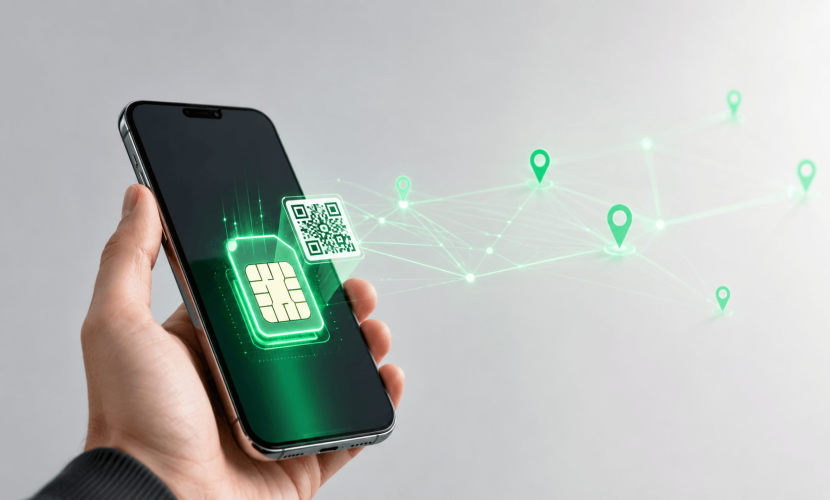
- Buy your plan: Pick your destination plan on Instant eSIM and get a QR code by email within minutes.
- Scan the QR code: Go to Settings → Mobile/Cellular → Add eSIM, then scan to install.
- Switch on data: Set the eSIM as your data line, enable data roaming for that line, and you are online.
New to eSIMs? Start with what an eSIM is and how it works, then follow our full eSIM setup guide. Tip: install it while you still have Wi-Fi.
Pro Tips to Stay Connected as a Nomad
- Always carry a data backup: Keep an eSIM ready even if you rely on local Wi-Fi — it saves you when a call drops.
- Buy before you fly: You need Wi-Fi to install your eSIM, so set it up before departure.
- Keep your home SIM for codes: Use the eSIM for data and your home number for banking OTPs and 2FA.
- Top up early: Refill your data before it runs out so you are never offline before a deadline.
- Schedule big downloads on Wi-Fi: Save OS updates and large files for café or apartment Wi-Fi to protect your data.
- Pack a power bank: Hotspotting your laptop drains your phone fast on long work days.
Frequently Asked Questions
What is the best eSIM for digital nomads?
For nomads who travel across many countries, a global eSIM is usually best because one plan works in 100+ destinations. If you stay mostly in one region, a regional eSIM offers better value per GB.
Can I use one eSIM in multiple countries?
Yes. Regional and global eSIMs are designed to work across many countries, so you stay connected as you move without buying a new plan each time.
Is an eSIM good enough for video calls and remote work?
Absolutely. eSIMs connect to reliable local networks, which is ideal for video calls, cloud syncing, and everyday work tasks — just pick a plan with enough data.
Can I top up my eSIM data while abroad?
Yes. Most plans let you top up or reactivate directly from your phone, so you can add more data without buying a brand-new eSIM.
Will I keep my own phone number?
Yes. Your eSIM runs alongside your existing SIM, so you keep receiving calls and messages on your home number while using the eSIM for data.
How much data should a nomad buy per month?
It depends on your work, but many remote workers use 50–100 GB a month. Choose a large bundle or an unlimited plan with easy top-ups to stay covered.
Your office moves with you — your connection should too.
Get an Instant eSIM and stay online for work and life in 100+ countries, wherever the road takes you.
Explore Global eSIM Plans →