eSIM Pros and Cons in 2026: Advantages, Disadvantages & Is It Worth It?
Thinking about switching to an eSIM but not totally convinced? You're not alone. eSIMs have quietly become the default way to stay connected — especially for travel — but plenty of people still wonder whether the technology is reliable, secure, and actually worth it. In this guide we lay out the real eSIM pros and cons, bust a few common myths, and help you decide if an eSIM is right for you in 2026.
Quick answer: For most modern smartphone users — and almost every traveller — the advantages of an eSIM (instant activation, no physical card, dual-SIM, lower cost) far outweigh the few drawbacks. If your phone supports eSIM and is unlocked, it's absolutely worth it. Browse Instant eSIM plans here.
What Is an eSIM? (A Quick Recap)
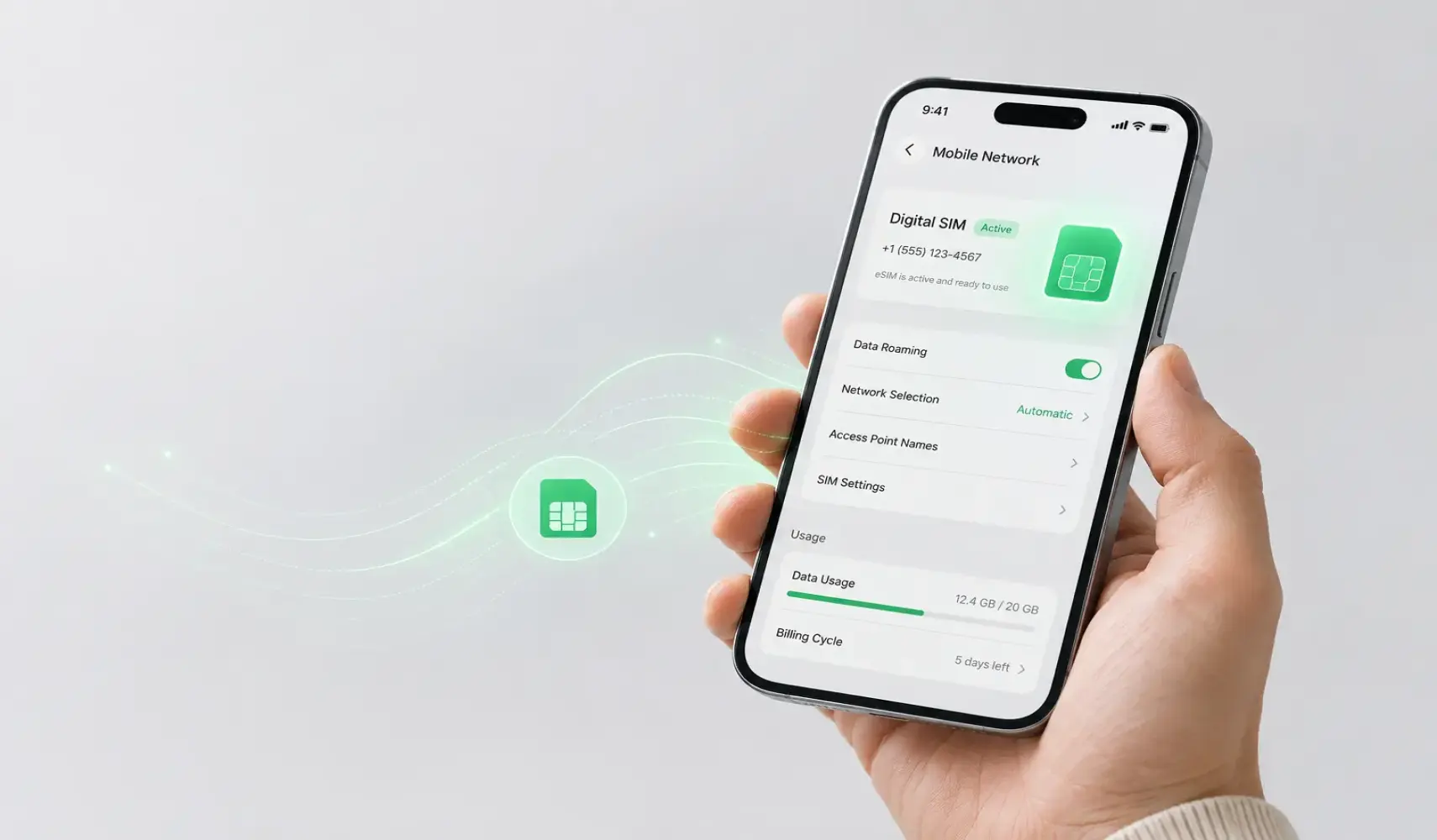
An eSIM (embedded SIM) is a digital SIM card built directly into your phone. Instead of inserting a tiny plastic card, you download a mobile plan onto your device — usually by scanning a QR code. The plan works exactly like a normal SIM, just without the physical chip. If you're brand new to the idea, start with our explainer on what an eSIM is and how it works.
eSIM Advantages (The Pros)
Here's why hundreds of millions of people have already made the switch.
- Instant activation, anywhere. Buy a plan online and activate it in minutes — no airport kiosks, no SIM-card stores, no shipping waits.
- Nothing physical to lose or swap. The SIM lives inside your phone, so there's no fiddly card to misplace, snap, or fumble with an ejector pin.
- True dual-SIM. Keep your home number active for calls and texts while a second eSIM handles data — ideal for travel and for separating work and personal lines.
- Cheaper than roaming. A prepaid travel eSIM avoids sky-high roaming fees and bill shock. See the breakdown in our eSIM vs roaming comparison.
- Switch plans & carriers easily. Store multiple eSIM profiles on one phone and toggle between them whenever you need a different network or country.
- More secure. An embedded SIM can't be physically removed by a thief, which makes a stolen phone harder to misuse and easier to track.
- Better for the planet. No plastic card, no packaging, no plastic waste — a small but real environmental win.
eSIM Disadvantages (The Cons)
To be fair and balanced, here are the genuine downsides — and how easy each one is to work around.
- Not every phone supports it. Older and some budget phones lack eSIM hardware. The fix: most phones from the last few years are eSIM-ready — check our eSIM-compatible devices list.
- Moving it to a new phone is less instant. You can't just pop a card into a new device; transferring may need a re-install or a quick reactivation. The fix: reputable providers let you reinstall easily, and newer phones support eSIM transfer over Bluetooth.
- You need internet to install it. Setup requires Wi-Fi or an existing connection. The fix: simply set up your travel eSIM at home before you fly — our setup guide walks you through it.
- First-time setup can feel unfamiliar. Scanning a QR code and choosing the right data line confuses some new users. The fix: it takes two minutes once you've done it, and our activation troubleshooting guide covers any hiccups.
- Most travel eSIMs are data-only. You usually don't get a local phone number. The fix: use WhatsApp, FaceTime or Messenger for calls and texts over data — and keep your home SIM active for your normal number.
- You can't lend it to a spare phone. Unlike a plastic SIM, an eSIM is tied to one device at a time. For most people this is a non-issue.
eSIM Pros vs Cons at a Glance
| Advantages (Pros) | Disadvantages (Cons) |
|---|---|
| Instant online activation | Needs a compatible, unlocked phone |
| No physical card to lose or swap | Transferring to a new phone is less instant |
| Dual-SIM: keep your home number | Internet needed for initial install |
| Cheaper than roaming | Travel plans are usually data-only |
| Easy to switch plans & carriers | Can't move to a spare phone instantly |
| More secure & eco-friendly | Slight learning curve for first-timers |
Convinced the pros win? Find a plan for your next trip.
Explore eSIM Plans →So, Is an eSIM Worth It in 2026?
For the vast majority of people, yes. The technology is mature, supported by every major network, and built into nearly all new phones. Whether it's the right call for you depends mostly on your phone and how you use it:
| If you are a… | Is an eSIM worth it? |
|---|---|
| Frequent traveller | Yes — the single biggest win. Land connected, skip roaming. |
| Digital nomad / remote worker | Yes — switch country plans instantly without buying SIMs. |
| Two-line user (work + personal) | Yes — run both numbers on one phone. |
| Someone with an older / locked phone | Maybe not yet — check compatibility first. |
| Person who swaps phones constantly | Worth it, but know that transfers take an extra step. |
4 Common eSIM Myths, Debunked
Myth 1: "eSIMs are less secure."
The opposite is true. Because an eSIM can't be physically pulled out, a stolen phone is harder to misuse, and profiles are encrypted and remotely manageable.
Myth 2: "An eSIM drains your battery."
An eSIM uses essentially the same power as a physical SIM. Any difference is negligible in everyday use.
Myth 3: "You lose your phone number."
Not at all. Your physical SIM and home number stay active while the eSIM simply adds a second line for data. Curious how they differ? Read eSIM vs physical SIM.
Myth 4: "eSIMs are complicated to set up."
Setup is usually a single QR-code scan that takes a couple of minutes. After your first time, it's second nature.
How to Check if Your Phone Supports eSIM
Most phones from the last few years are eSIM-ready — including iPhone XS and newer, Google Pixel 3 and newer, and recent Samsung Galaxy S, Note, Z Fold and Z Flip models. Your phone also needs to be carrier-unlocked. To check: on iPhone go to Settings → General → About and look for an EID number; on Android dial *#06# and look for an EID. If one appears, you're good to go.
Frequently Asked Questions
Are eSIMs worth it for travel?
Yes — for travel they're the standout choice. You set up a plan before you fly, land connected, avoid roaming charges, and keep your home number for calls. See our best travel eSIM plans compared.
Is an eSIM safe and secure?
Yes. eSIM profiles are encrypted and can't be physically removed, making them at least as secure as — and arguably safer than — a traditional SIM card.
Can I move my eSIM to a new phone?
Yes, though it takes an extra step compared with swapping a physical card. Many providers let you reinstall on a new device, and newer phones support eSIM transfer over Bluetooth.
Does an eSIM replace my physical SIM?
It doesn't have to. On a dual-SIM phone you can run your physical SIM and an eSIM side by side, using each for different purposes.
Do eSIMs work without Wi-Fi?
Once installed, an eSIM works on mobile data just like a normal SIM — no Wi-Fi needed. You only need an internet connection for the one-time setup, which you can do at home before travelling.
How much data should I get on an eSIM?
It depends on your trip length and usage. Our guide on how much eSIM data you need breaks it down by traveller type.
Ready to Try an eSIM?
Instant activation. No roaming bills. Coverage in 130+ destinations worldwide.
Get Your eSIM →Want the step-by-step? Read our guide on how to set up an eSIM for international travel.